
Two Chair Quotes Look Similar. Are You Comparing the Same Specifications?
A buyer-focused checklist for comparing chair quotations beyond the unit price.
The price was clear. The comparison was not.
Short answer: two folding camping chair quotations that look similar are not necessarily comparable. Align the product definition, measurement basis, materials, packing, quantity and price conditions before treating a lower unit price as a like-for-like result.
When I went back to two supplier quotations from a real folding camping chair project, the small price difference was not what made me pause. It was how many apparently matching specifications still needed interpretation.
Both quotations showed a similar chair. Both listed the same overall dimensions, the same nominal tube diameter, two tube wall-thickness options and 600D Oxford fabric. Both specified ten chairs per carton. Quotation B was slightly cheaper and the customer selected B, but the quotation sheets did not provide a complete answer about whether the products and commercial conditions were truly comparable.
What the two quotations actually showed.
The following comparison is based on the original supplier quotations. Supplier names, model numbers, exact order quantities, total values and other commercially sensitive information have been removed. The comparison did not produce a simple “same” or “different” answer; it separated what appeared aligned, what differed and what still required clarification.
| Comparison point | Quotation A | Quotation B | What the documents showed |
|---|---|---|---|
| Product category | Folding camping chair | Folding camping chair | Appeared aligned as written |
| Product photo | Visually similar | Visually similar | Appearance did not confirm identical construction |
| Stated open dimensions | Same three dimensions | Same three dimensions | Measurement directions were not labeled |
| Main frame tube | Same nominal diameter and two wall-thickness options | Same nominal diameter and two wall-thickness options | Listed figures appeared aligned |
| Fabric | Double-layer 600D Oxford, PE coated | 600D Oxford, described as waterproof | Descriptions were not directly comparable |
| Frame finish and connectors | Not clearly stated | Powder coating and ABS connectors stated | Information appeared in only one quotation |
| Carry or storage bag | 210D polyester listed under packaging | 210D Oxford storage bag listed | It was unclear whether these referred to the same bag |
| Maximum-load information | A load figure was stated | Not stated | No direct comparison was possible |
| Product and carton weight | Gross carton weight stated | Product weight and net/gross carton weight stated | Information used different bases |
| Export carton | Ten chairs per carton | Ten chairs per carton | One carton dimension differed |
| Quoted order quantity | Lower quantity basis | Higher quantity basis | The quotation basis was different |
| Thicker-tube option price | Slightly higher | Slightly lower | Small difference under different quantity bases |
| Thinner-tube option price | Same unit price | Same unit price | No price difference for this option |
| Point to clarify | Why it helps |
|---|---|
| Dimensions and measurement points | Makes open dimensions comparable rather than visually assumed. |
| Frame, fabric and coating definitions | Separates construction terms from unverified performance language. |
| Included accessories and packing | Keeps the delivered configuration beside the unit price. |
| Quantity and delivery basis | Prevents different commercial assumptions from being compared as one offer. |
Matching numbers still needed a shared definition.
The two quotations listed the same open dimensions, but neither supplier labeled width, depth and height on a photograph or drawing. The measurement points were not shown either. The dimensions may have been taken in exactly the same way; the documents simply did not confirm it.
Both suppliers listed the same nominal tube diameter and two wall-thickness options, but the sheets did not clearly identify every frame component to which those figures applied. A matching number is useful. A matching number with a shared definition is more useful.
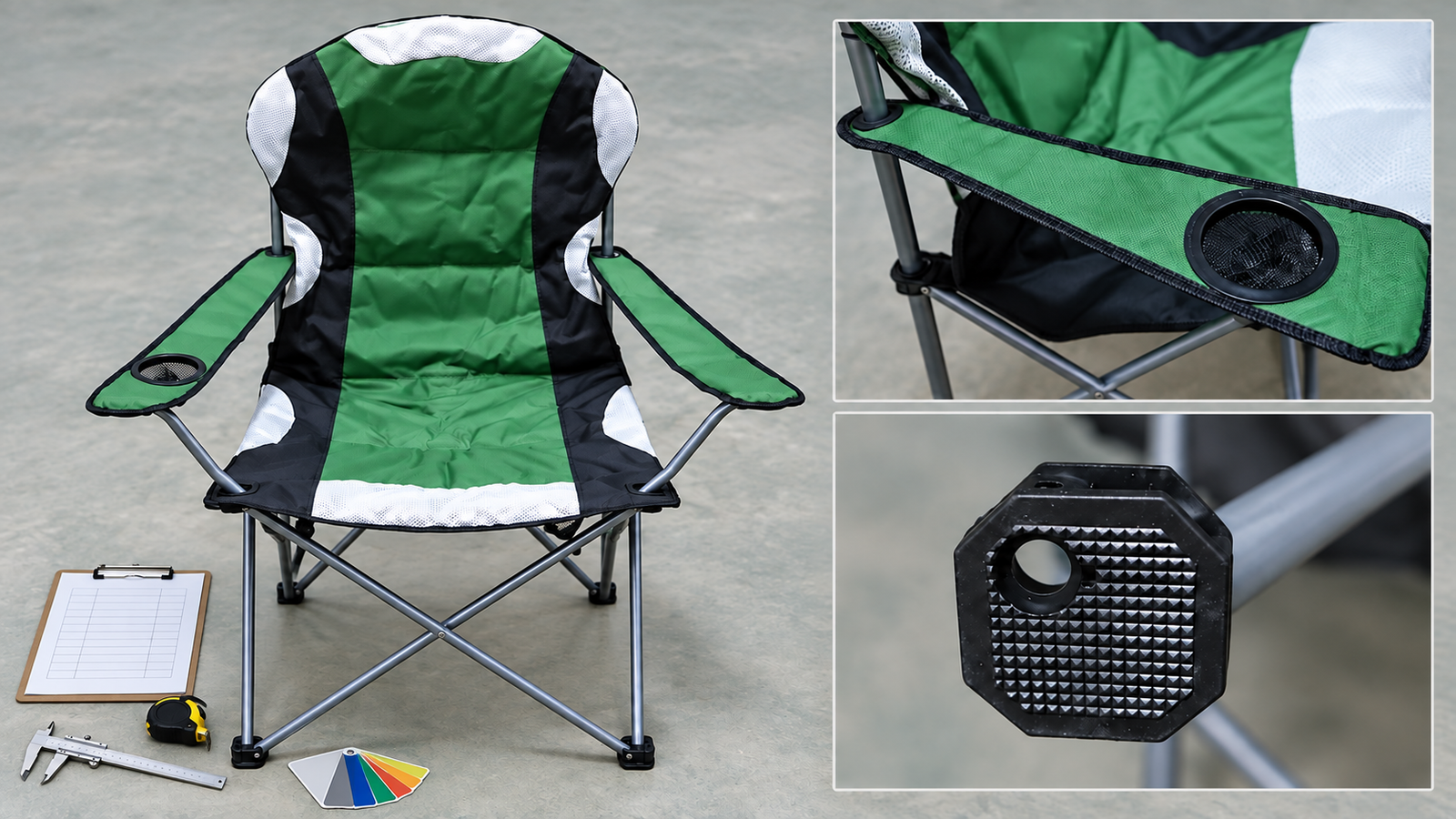
One marked photograph could have clarified the measurement directions and relevant frame sections without requiring a complete engineering drawing. The GS1 Package and Product Measurement Standard addresses a broader trade-item measurement context, but its underlying principle is relevant: measurements become more useful when object, orientation and method are defined consistently.
The material descriptions were not directly comparable.
Both suppliers referred to 600D Oxford fabric. Quotation A described “double-layer 600D Oxford, PE coated”; quotation B described “waterproof 600D Oxford.” These might have been different descriptions of a similar fabric, or different fabric constructions.
“Double-layer” refers to construction. “PE coated” identifies a stated coating. “Waterproof” is a performance description. Before comparing the fabrics, both suppliers would need to describe the same fields. The word “waterproof” is retained because it appeared in the quotation; this article does not independently verify that performance claim.
- Fabric construction
- Coating or backing
- The chair component to which the description applies
- The basis of any performance claim that matters to the purchase
Missing information did not prove that a feature was absent.
Quotation B listed powder coating and ABS connectors. Quotation A did not clearly mention either. That did not prove that A’s chair lacked powder coating or used different connectors.
It would have been tempting to fill in blanks from the product photo, but it would also have been wrong to treat missing fields as confirmed product differences. The same issue appeared in the bag descriptions: one quotation listed 210D polyester and the other referred to a 210D Oxford storage bag. “Not stated” is not the same as “not included”; it means the comparison still requires clarification.
The lower price was real, but the comparison basis was different.
For the thicker-tube option, B’s quoted unit price was slightly lower. For the thinner-tube option, the two prices were the same. The quotations were based on different order quantities, and the cartons differed slightly in one dimension while product and carton weights were presented on different bases.
This does not prove that quantity caused the price difference. It does mean that the prices were not being compared under exactly the same conditions. Before interpreting the remaining difference, both suppliers should ideally quote the same supplied and packed configuration.
- Tube option
- Order quantity
- Included accessories
- Individual packing
- Export-carton requirements
- Incoterm and named delivery point
Why the price became decisive.
The customer selected B because the quoted price for the option under consideration was lower. This does not necessarily mean the customer was careless or that the final choice was wrong. The quotation sheets simply made price much easier to compare than the product itself.
The unresolved product differences were spread across material descriptions, missing fields, packing details, weights and quantity assumptions. Price gave the buyer an immediate answer; the product comparison still required interpretation. Quotation B may still have been the right choice, but the available comparison did not explain what the lower price represented.
Three questions that would have made the comparison clearer.
The buyer did not need a complete manufacturing file before making progress. Three focused requests would have addressed the most important gaps. The answers might have confirmed that the products were the same, revealed meaningful differences or left a few points unresolved. Any of those outcomes would have made the price easier to understand.
- Mark the dimensions: mark open dimensions on a product photo or drawing and identify width, depth and height measurement points.
- Align material descriptions: confirm frame finish, connector material, fabric construction and coating, and identify the chair components covered.
- Quote the same supplied and packed configuration: confirm included items, carry-bag specification, product weight, individual packing, export-carton details, order quantity, Incoterm and named delivery point.
Source and further reading.
The lesson is not that buyers should stop choosing the lower quotation. It is that the lower number becomes more meaningful after the products and quotation conditions have been described on the same basis.
This article includes an anonymized comparison based on two actual supplier quotation sheets. Supplier identities and commercially sensitive figures have been removed. The quotation details reflect what appeared in those documents; they are not product-test results, certifications or conclusions about either supplier. The stated reason for the customer’s decision is based on direct business recollection rather than a contemporaneous written decision record. External evidence reviewed through August 31, 2026.
- GS1 Package and Product Measurement Standard
Keep reading
Related Resources
Need a clearer comparison for your buying program?
Share the product, use case or quotation detail you are working with.